Bedding guide
Choosing a Winter-Ready Comforter: Fill Power, Weight, and Construction
A comforter that looks impressively lofty in a product description may still leave you chilly—or have you nudging it off the bed before midnight. For Canadian winters and the shoulder seasons around them, warmth depends on a more practical combination: the fill’s loft, the amount of fill, the construction of the comforter, and the conditions in your bedroom.
Published October 11, 2026
Winter bedding is often discussed as if warmth could be settled by a single number. A high fill-power rating appears, the specifications grow confident, and the question seems answered. But fill power is not a thermostat setting. It describes how much space a given weight of down occupies when it lofts; it does not say how much down is inside the comforter, how the chambers are sewn, or whether the room is cold enough to call for a substantial winter weight.
That distinction matters in Canada, where “winter” can mean an older house with a cool bedroom, a well-insulated condo with steady heat, or a guest room that seems to lose several degrees after sunset. The best goose down comforter for one setting may feel excessive in another. A useful comparison begins not with the most extravagant specification, but with the way the bedding will actually be used.
Think of a comforter as a small system. The down provides insulation, the shell contains it, and the construction governs how evenly the fill occupies the surface. Room temperature, sleepwear, mattress warmth, and personal preference complete the arrangement. Once these parts are considered together, choosing seasonal bedding becomes less a matter of deciphering luxury language and more a matter of matching materials to a familiar night.
What fill power tells you—and what it leaves out
Down consists of the soft clusters beneath a bird’s outer feathers. These clusters trap air, and trapped air is what helps slow heat loss. Fill power is a measure of the loft of a specified amount of down, commonly expressed in cubic inches per ounce. In general, a higher number indicates that the down can occupy more space for its weight.
That can be useful. Down with more loft may provide substantial insulation without requiring as much weight, which helps explain the appealing combination of warmth and lightness associated with a well-made down comforter. But a fill-power rating alone cannot tell you whether a comforter is warm enough for a drafty bedroom. Nor does it directly measure softness, durability, or the quality of the entire product.
Consider two comforters with the same fill power. One may contain a relatively modest amount of down and be intended for summer use; the other may have a greater fill weight and be made for winter. Their down has comparable loft potential, but the comforters do not necessarily provide comparable warmth. In the same way, a lower-fill-power comforter with more filling may feel warmer than a high-fill-power one with less.
Fill power is most useful when read alongside other specifications. Look for the fill material and percentage, total fill weight, available warmth options, construction, and shell fabric. If a listing emphasizes a number but omits the amount of fill or the intended season, the number offers only part of the picture.
- Fill power describes the loft potential of the down, not the comforter’s total warmth on its own.
- Fill weight tells you how much filling is used, though it needs to be considered with the comforter’s size and design.
- Warmth level translates product design into a practical use category, such as summer, year-round, or winter.
- Construction and shell influence how the filling is distributed and how the comforter feels against the body.
Fill weight: the less glamorous number with a practical job
Fill weight is the amount of down inside the comforter. It is a key part of the warmth equation because a comforter needs enough insulation for its intended use. Still, a number of ounces cannot be compared casually across every product: sizes differ, warmth goals differ, and construction may vary. A larger comforter naturally requires more filling to cover its area than a smaller one.
When specifications provide fill weights by size and warmth level, compare like with like. A queen winter comforter should be compared with other queen winter options, not with a twin summer model or a king described simply as “all season.” Product labels are helpful shorthand, but the underlying figures can reveal how a maker interprets those labels.
Warmth also depends on how much of the bed the comforter covers. If it is too narrow, the sides may pull away when sleepers move. A blanket that leaves shoulders or feet exposed can seem under-insulated even when the fill itself is warm. Check dimensions as carefully as fill weight, particularly if the mattress is deep or you prefer generous overhang.
For shoppers comparing premium bedding, the Buxton Duvet offers one example of specifications that describe more than a headline fill-power figure: European white goose down, cotton ticking, 12-inch baffle-box construction, and corner loops. It is presented as a duvet for light loft and consistent warmth. Those details help explain the design, but the right choice still depends on the listed size, warmth level, bedroom conditions, and the manufacturer’s complete current specifications.
Choosing among summer, year-round, and winter weights
Seasonal labels provide a useful first filter. A summer-weight comforter is generally designed for mild conditions or sleepers who tend to feel warm. A year-round option aims for a middle ground. A winter-weight comforter contains more insulation, or is otherwise designed to provide greater warmth, for colder rooms and people who prefer a cosier bed.
These terms are not perfectly standardized across manufacturers. “All season” might suit a heated home where the bedroom stays temperate, yet feel skimpy in an older house with a cold exterior wall. Conversely, a substantial winter comforter can feel heavy and overly warm in a tightly insulated room. Use the label as a starting point, then consider your thermostat habits and how you feel under existing bedding.
A few questions make the choice more concrete:
- Does your bedroom stay warm overnight, or does its temperature fall noticeably after the heating cycles off?
- Do you usually wake feeling too warm, comfortably warm, or in need of another blanket?
- Will the comforter be used alone, or layered with a blanket or coverlet?
- Are two people sharing the bed with different temperature preferences?
- Would separate seasonal comforters be practical, or do you want one moderate option?
For a room that runs cool, a winter weight may be a sensible choice. For a consistently heated bedroom or a person who sleeps warm, a year-round or lighter option may be more comfortable. If preferences differ across a shared bed, a dual-zone design or separate layers can be less contentious than asking one comforter to satisfy two opposing climates.
Baffle box and sewn-through construction
Down is loose fill; the comforter’s chambers keep it where it belongs. Construction affects whether filling can loft evenly, whether it shifts over time, and how much insulation sits at the seams.
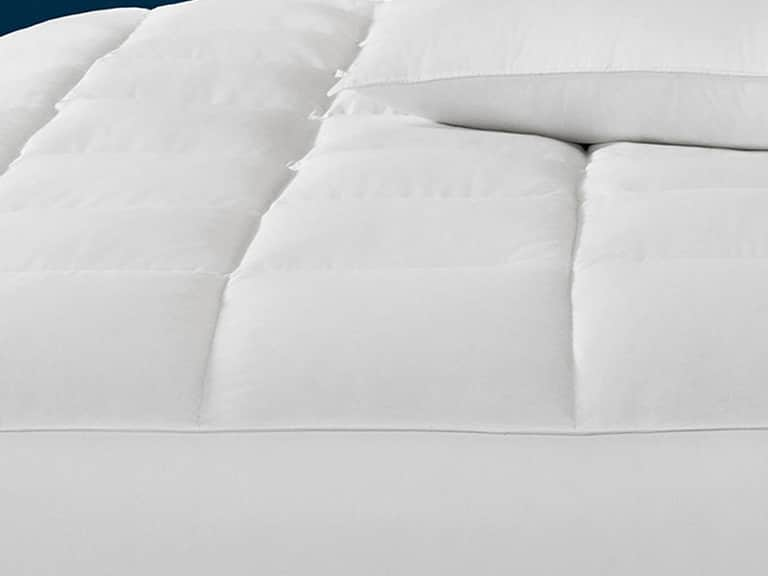
In a baffle-box design, fabric walls join the top and bottom shell layers to create three-dimensional compartments. Those internal walls allow down to expand in the chambers instead of being compressed between flat stitches. A well-made baffle box can support a fuller profile and help reduce the risk of thin areas forming between compartments. It does not guarantee that a comforter will be warm enough, but it can help maintain a more even distribution of the fill.
Sewn-through construction joins the top and bottom fabric directly at the stitching lines. This creates a simpler, flatter pattern of pockets. Because the fill is compressed where the seams meet, those lines may provide less insulation than the lofted areas between them. Sewn-through comforters can nevertheless be appropriate for lighter warmth levels, and the construction is not automatically a sign of poor quality. The relevant question is whether the design suits the intended season and use.
Neither method should be judged in isolation. The scale of the boxes, the amount and quality of fill, the care in sewing, and the comforter’s overall design all contribute to performance. Descriptions such as “baffle box” are most meaningful when paired with clear information about fill, warmth, dimensions, and care.
The shell: a quiet influence on warmth and comfort
The shell is the fabric surrounding the down. Cotton is common, with variations in weave and finish that affect hand feel, airflow, durability, and how securely the filling is contained. Some comforters use other fibres, including lyocell or silk. A shell can feel crisp, smooth, soft, or almost weightless, and those sensations matter because the comforter is in close contact with the sleeper throughout the night.
A tightly woven, down-proof shell helps keep small clusters from escaping through the fabric. Breathability also matters: insulation that traps warmth effectively should not feel clammy in a bedroom that is already warm. Thread count can provide a clue about fabric density, but it is not a universal score for quality. Fibre, yarn, weave, finishing, and construction contribute to the actual feel.
Shell choice is therefore partly tactile and partly practical. Someone who values a natural cotton surface may choose a cotton-covered duvet; another sleeper may prefer the smoother feel of a different fibre. When possible, compare fabric descriptions with care instructions. A specialty shell may require professional cleaning, while another comforter may permit careful machine washing in appropriate equipment. These differences affect the life and upkeep of the bedding, not merely its first impression.
Canadian winters, bedroom climates, and changing seasons
Canada’s climate is too varied for a single national prescription. A cold snap on the Prairies, a damp coastal winter, and a heated apartment in a large city produce different bedroom conditions. Even within one home, the upstairs room, the basement guest room, and the room above a garage may behave like separate climates.
It is useful to think in terms of the room rather than the forecast. A comforter does not know that it is January; it responds to the warmth retained by the bedroom and the sleeper. Window quality, insulation, heating schedules, air circulation, and the number of people sharing a bed can all alter how warm bedding feels. The same comforter may be comfortable in a cool room and stifling in a heated one.
Layering can provide flexibility. A moderate comforter paired with a removable blanket lets sleepers adjust more easily when seasons change or household preferences differ. Others prefer one comforter that can be aired, stored, and replaced with a lighter option as temperatures rise. Neither approach is inherently superior; the better arrangement is the one you can manage comfortably.
Down, goose down, and the meaning of product claims
Goose down is often associated with large clusters and lofty insulation, but species alone does not determine how a comforter performs. Fill quality, cleanliness, cluster composition, fill weight, processing, and construction matter. A carefully specified product should make its material claims clearly, including whether the fill is pure down or a blend that also contains feathers.
White describes colour, not a separate guarantee of warmth or ethical sourcing. Canadian white goose down, meanwhile, signals a claimed geographic origin that should be read in the context of the product’s sourcing details. Manufacturing location and fill origin are not necessarily the same: a duvet can be assembled in one country with down sourced from another.
For consumers concerned about animal welfare, look for the name of a standard or certification and verify what it covers. A Responsible Down Standard claim, for example, relates to sourcing and animal-welfare requirements within its certification system; it does not by itself determine warmth, durability, or every environmental attribute of the finished comforter. A clear label is a starting point for questions, not a substitute for understanding the product.
Construction details that make daily use easier
Corner loops are small features with a useful purpose: they attach to ties inside a duvet cover, helping the insert stay in place. Without a secure connection, a comforter may bunch toward one end or slip inside the cover as sleepers move. Piped edges can reinforce the perimeter and give it a finished outline, though appearance should not be confused with insulation.
Box dimensions, gussets, and stitching patterns also influence shape. A gusset can add height around the edge of some designs, while chamber construction helps distribute fill. These are not interchangeable terms, and details vary by maker. If cold spots are a concern, ask how the fill is divided and whether the design keeps it from migrating. If shifting inside the duvet cover is the main irritation, check for corner loops and compatible interior ties.
Care, storage, and the lifespan of a comforter
Down needs to remain dry and able to loft. A duvet cover is a simple form of protection from body oils, spills, and everyday soil, and it can reduce the frequency with which the insert needs cleaning. Regular gentle airing and occasional fluffing may help refresh the fill, but care advice differs by product, especially where shells or finishes are concerned.
Always follow the care label rather than applying a universal rule. Some comforters are described as machine washable under specific conditions; others should be entrusted to a cleaner experienced with down-filled bedding. A domestic washer may be too small, and an agitator can stress the fabric and seams. If the label permits home laundering, use the recommended machine, detergent, temperature, and drying method. In every case, down must be dried thoroughly: lingering moisture can encourage odour and damage the filling.
For seasonal storage, use a clean, breathable fabric bag or other storage method recommended by the maker. Sealed plastic can trap moisture, particularly if the comforter is not completely dry. Store it loosely rather than compressing it for long periods, and keep it in a dry place. Preserving the loft is not a matter of ceremony; it is part of keeping the insulation functional.
A practical comparison checklist
Before choosing a winter-ready comforter, gather the details that explain how it is likely to behave. A short checklist can keep attractive marketing language from overshadowing the essentials:
- Identify the fill: goose down, duck down, a down-and-feather blend, or another insulation.
- Read fill power as a measure of loft, not as a complete warmth rating.
- Compare fill weight only across similar sizes and intended warmth levels.
- Look for a clearly stated season or warmth category, then consider your bedroom temperature.
- Check whether the design uses baffle-box or sewn-through construction.
- Review shell material, feel, down-proof properties, and care requirements.
- Confirm dimensions, corner attachments, and the fit with your duvet cover.
- Read sourcing and certification claims carefully, distinguishing welfare information from performance claims.
The right warmth is personal, but the comparison need not be guesswork
A winter comforter should make a bed feel inviting without turning sleep into a negotiation with the thermostat. Fill power helps describe the loft of down; fill weight and warmth category help describe the amount of insulation; construction influences the way that insulation is held and distributed. Shell fabric, fit, room temperature, and care complete the picture.
Start with the bedroom you have, not the coldest night you can imagine. If the room is reliably cool, compare winter-weight options with ample, clearly described fill and a construction suited to even distribution. If temperatures fluctuate, consider a year-round comforter with a removable layer nearby. If you sleep warm, a lighter weight may be the more luxurious choice—not because it is grander, but because it lets you sleep without thinking about it.
In the end, the best goose down comforter in Canada is not necessarily the one with the largest number on its label. It is the one whose fill, weight, construction, and shell suit the bed, the room, and the sleeper beneath it. That is a quieter kind of specification, but a more useful one.